Huanchaco
The SwarmHuanchaco, on Peru’s northern Pacific coast, is both a working fishing community reshaped by tourism and the setting of one of the earliest recorded signs of the global ocean crisis. On 14 January, Juan Narciso Ucañan disappears while fishing offshore. His fate goes unnoticed at first; weeks later, as reports of missing people and boats accumulate, his experience becomes part of a pattern that the world can identify but cannot yet explain. Huanchaco’s importance lies in that contrast: a place presented to visitors as a timeless seaside paradise is also where the story’s widening emergency first becomes legible.
Coastline and changing livelihoods
Huanchaco has been remade as an international beach resort. Tourists see a preserved, old-fashioned way of life in the fishermen and their distinctive reed craft, but that image conceals how little security the traditional livelihood offers. Fishing boats of this kind have become an anachronism for many Peruvians, who instead work on factory trawlers or in the fishmeal and fish-oil industries. Peru’s fish stocks are dwindling even as its fishing industry remains among the largest in the world.
The town’s physical expansion carries a related cost. Despite the threat of El Niño, hotels spread outward, replacing remaining natural spaces. Prosperity has reached much of the community in one form or another, but Ucañan sees himself as left with almost nothing: his boat, a caballito de totora, or reed pony. The craft, admired by the conquistadors who named it, embodies a local tradition that is becoming difficult to sustain. Its picturesque appearance serves tourists as a sign of continuity; for a fisherman, it is also a vulnerable tool of work in a changing economy.
Ucañan’s morning offshore
On the morning he vanishes, the weather is clear and the coast appears serene. Ucañan and roughly a dozen other fishermen have paddled out in darkness, about half an hour before the first light. As the sun rises behind mist-shrouded mountains, the water changes from silver to pale blue. Cargo ships are visible in the distance, heading toward Lima. The scene’s calmness offers no warning of what is happening to the fishermen.
Ucañan tends his equipment rather than the view. He checks his calcal, a traditional red fishing net a few metres long, woven closely and fitted with hooks of different sizes. His caballito has no seat: a fisherman must straddle it or crouch on top, with room at the stern for nets and other gear. The paddle he carries, made from split guayaquil cane, belonged to his father. Since his father fell ill, Ucañan has laid it beside him each evening and placed the older man’s right hand over it, so he can feel that the paddle—and the tradition it represents—remains present. That intimate practice joins the day’s dangerous work to a family inheritance, just as the old boat joins present-day fishing to Huanchaco’s past.
Disappearance and belated recognition
Ucañan’s disappearance is initially one loss among many that draw little notice. The narrative stresses that no one in the town is watching for him, and that even before the crisis he felt overlooked. When the circumstances of his vanishing later send shockwaves around the world, his name is still absent from the public account. His experience is understood only retrospectively, through parallels with events elsewhere; without his testimony, the mystery remains unresolved. The coast and the Pacific reveal nothing about what happened to him.
In a later briefing, Major Salomon Peak identifies Huanchaco as the point where the unfolding series of disappearances began for the purposes of his presentation, while allowing that events may have started somewhere else. He reports that twenty-two fishermen disappear from the area over a few days despite fine weather. Some boats are subsequently found drifting out to sea; other disappearances leave only scraps of debris, or no trace. Ucañan’s individual story is thus absorbed into a count. The shift is consequential: what the opening presents as an unobserved fate becomes evidence in an international crisis, but that new visibility does not restore the missing person’s name or account.
The shoal in the surveillance image
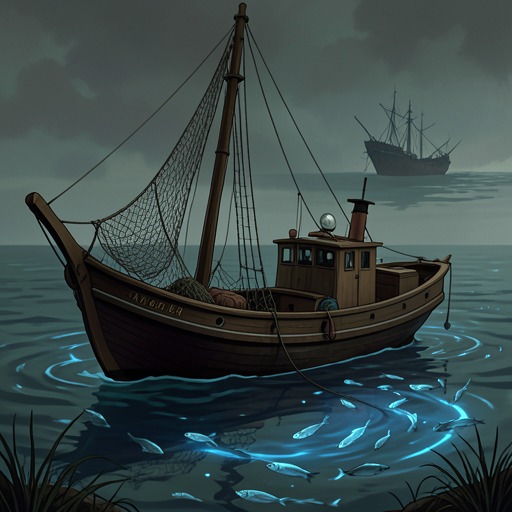
Huanchaco’s offshore waters become important again when Peak presents imagery from a KH-12 satellite. The close-up shows the shelf near the town, where fishermen disappeared that day. In the image, an extensive silvery patch lies beneath the surface, and two small reed boats pass over it. Peak identifies the patch as an enormous shoal of fish, swarming about three metres underwater. The image makes visible a feature the missing fishermen may have encountered, but it does not establish what happened to them.
The scene also exposes the limits of surveillance. Ocean instruments and research vessels continually measure conditions such as salinity, temperature, carbon-dioxide flux, and current velocity, while satellites watch from above. Yet a geostationary satellite at 35,888 kilometres cannot resolve objects smaller than about eight kilometres; a boat can disappear within that blind spot. In the KH-12 close-up, optical systems can see a little below the surface because the water is clear enough, but the evidence remains partial. The fish may be South American sardines, Peak acknowledges; what makes the shoal alarming is its abundance in waters already known to be seriously overfished.
Peak connects the Huanchaco shoal to a wider series of reports: large fish shoals appear where swimmers, divers, and small boats have gone missing, and unusual shoaling has been reported elsewhere. One example is a herring shoal off Norway that pulls a nineteen-metre trawler under after the fish in its net turn and swim toward the seabed. That episode does not prove a direct connection to Huanchaco, but it changes how the Peruvian image is read. The shoal is no longer merely a spectacle of marine abundance; in the context of repeated disappearances, it becomes a clue to an ocean whose behavior humans can observe without yet understanding.
Significance in the wider crisis
Huanchaco’s role is not that it supplies a complete explanation for the global events, but that it concentrates the story’s central tensions. A community dependent on diminishing fish stocks is already living with ecological and economic change before the disappearances attract attention. Its traditional boats are at once practical vessels, remnants of an inherited culture, and small marks on a satellite image. The people who know this coast most closely are exposed to danger, while distant systems turn their losses into data.
The town’s calm morning and the later image of the shoal create a sharp contrast between human scale and planetary scale. Ucañan’s paddle carries a father’s touch and a local tradition; the satellite records reed boats as tiny shapes above a mass of fish. Neither view is sufficient on its own. Together they make Huanchaco an early threshold in the crisis: a particular place where a fisherman’s unexplained disappearance, the fragility of local livelihoods, and a recurring anomaly in the sea begin to form a pattern.